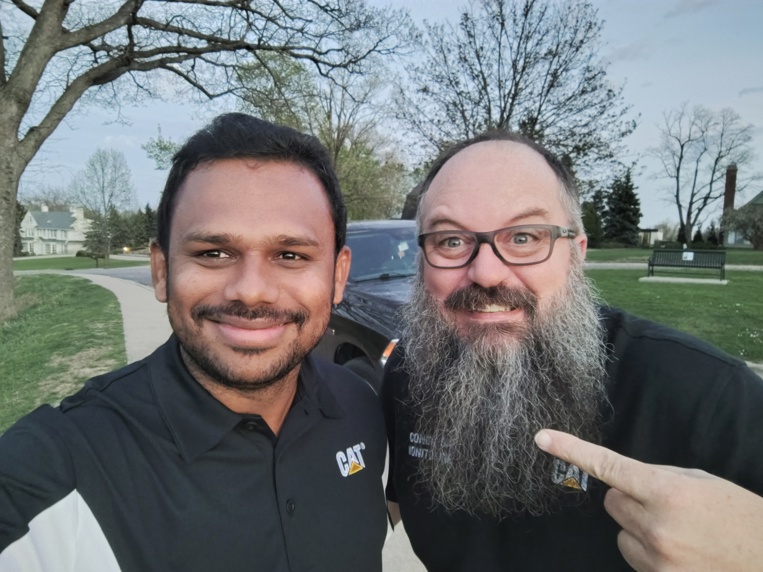
When Chandru began his career in 2016, Condition Monitoring wasn't a career path he was very familiar with. Instead of planning around job titles that were already defined, Chandru focused on something more future ready by understanding how technology was evolving and what customers would need next.
 |
Starting out in engine validation and engine calibration, Chandru gained hands-on experience with products enabling him to see real-world challenges up close and learning to solve them. Over time, he realized that true value lies not just in fixing problems, but in preventing them altogether. As data analytics and new digital platforms emerged, he focused on mastering tools that evaluate machine health, operating conditions, and performance patterns to predict potential downtime before it impacts customers. That mindset shift opened the door for him to grow, and today, Chandru is a Training consultant in the domain of Condition Monitoring Operations at our Chennai office. His objective is to support people in building skills and competencies in a role that didn’t exist in the region when he started his career. He believes most career planning still happens around existing roles, but the real opportunity lies in staying agile and flexible as the world continues to change. Drawing from his journey as a trainer in this fast-growing career, Chandru shares five evergreen skills that can help engineers transition beyond traditional technology, design, or manufacturing roles and create greater impact: |
-
Agility & flexibility: Understanding customer values, adapting quickly, and keeping customer satisfaction at the center of every decision.
-
Data analysis: Machines generate massive amounts of data, but value comes from connecting the dots, spotting patterns, and uncovering insights that aren’t immediately visible.
-
Empathy: Putting yourself in the customer’s shoes to understand problems that may not always be spoken and helping solve what truly matters.
-
Effective communication: Being able to shift roles between facilitator, consultant, and subject matter expert while clearly exchanging ideas, insights, and expectations.
-
Working with AI: Seeing AI as an enabler — and learning how to work alongside technology to add value in ways that truly matter.
Chandru says,“Technology will reshape how we work and how we add value. Understanding and aligning with that change is what helps us grow in an evolving world.”✨