


Innovation is no longer confined to projects or pilot programs — it’s reshaping how work gets done and how careers grow. As manufacturing becomes more connected, automated and data driven, new professional profiles are emerging to bridge technology, process and human behavior.
One example is the painting robot operator, a role created to connect deep knowledge of painting processes with the logic of automation. Rather than simply overseeing a machine, this role focuses on performance, data interpretation, continuous improvement and collaboration across disciplines.
The painting robot operator role was born from the need to streamline the painting process to new levels of safety, efficiency and quality, fully aligned with Operational Excellence and transforming how we work in support of Caterpillar's Strategic Plan for Profitable Growth.
The technology reduces ergonomic risks and high-energy activities in paint booths, while ensuring a more uniform application of the film, with greater repeatability and standardization. The result is a safer, more productive and predictable process, with gains in speed and reduced ink consumption.
The First Two
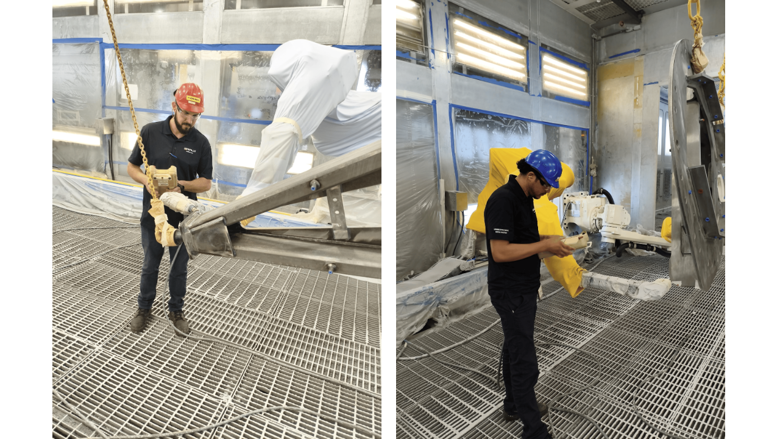
Two employees, Everton N. and Fabio P., were among the first to step into this new position at the Piracicaba facility in Brazil, bringing curiosity and a growth mindset to a role designed for the future. For Everton, the opportunity stood out as a chance to develop professionally at the intersection of technology and manufacturing. “It was an invitation to grow,” he said. “Innovation and technology are areas that motivate me.”
The day-to-day work goes far beyond monitoring equipment. Painting robot operators analyze performance data, intervene when adjustments are needed and work closely with engineering teams to refine programs and improve outcomes. The role demands both technical skill and strong behaviors — clear communication, urgency, customer focus and a willingness to think differently.
Fabio described the experience as “pioneering.” With no prior background in robotics, he was drawn to the chance to learn something entirely new while helping shape a role that didn’t previously exist. “It changed how I see innovation in production,” he noted. “Even in complex processes, there’s room to introduce new technologies and new ways of working.”
Behaviors guide success
Everton and Fabio brought behaviors that were necessary for success in the role:
- A customer-oriented mindset
- Open and direct communication
- Acting with urgency
- Thinking differently
- Accelerating quick wins
These behaviors are not abstract ideals; they are visible in the painting robot operators’ daily actions. From experimenting with new approaches to building on quick successes, Everton and Fabio are applying what they learn in real time, even as they adapt to new tools and processes.
Power of our people
The creation of the painting robot operator role required a structured selection and training process, open to employees across the painting operation. Candidates were evaluated on technical knowledge — such as painting processes, quality tools, lean principles and programming fundamentals — as well as collaboration, communication and innovative thinking. Training continues in partnership with technology providers, with plans to expand the role as operational needs grow.
The introduction of painting robots was driven by a clear business need: improving efficiency, quality and safety. Automation reduces ergonomic risks and high energy tasks, while delivering more consistent, repeatable results and reducing material use. But technology alone doesn’t deliver value. People do.


